What Happens When You Ask AI: What Is the Best MAM Platform?
Search for the best MAM platform and the answer is not simple. We asked the big question to various AI models to understand how the MAM market is changing.
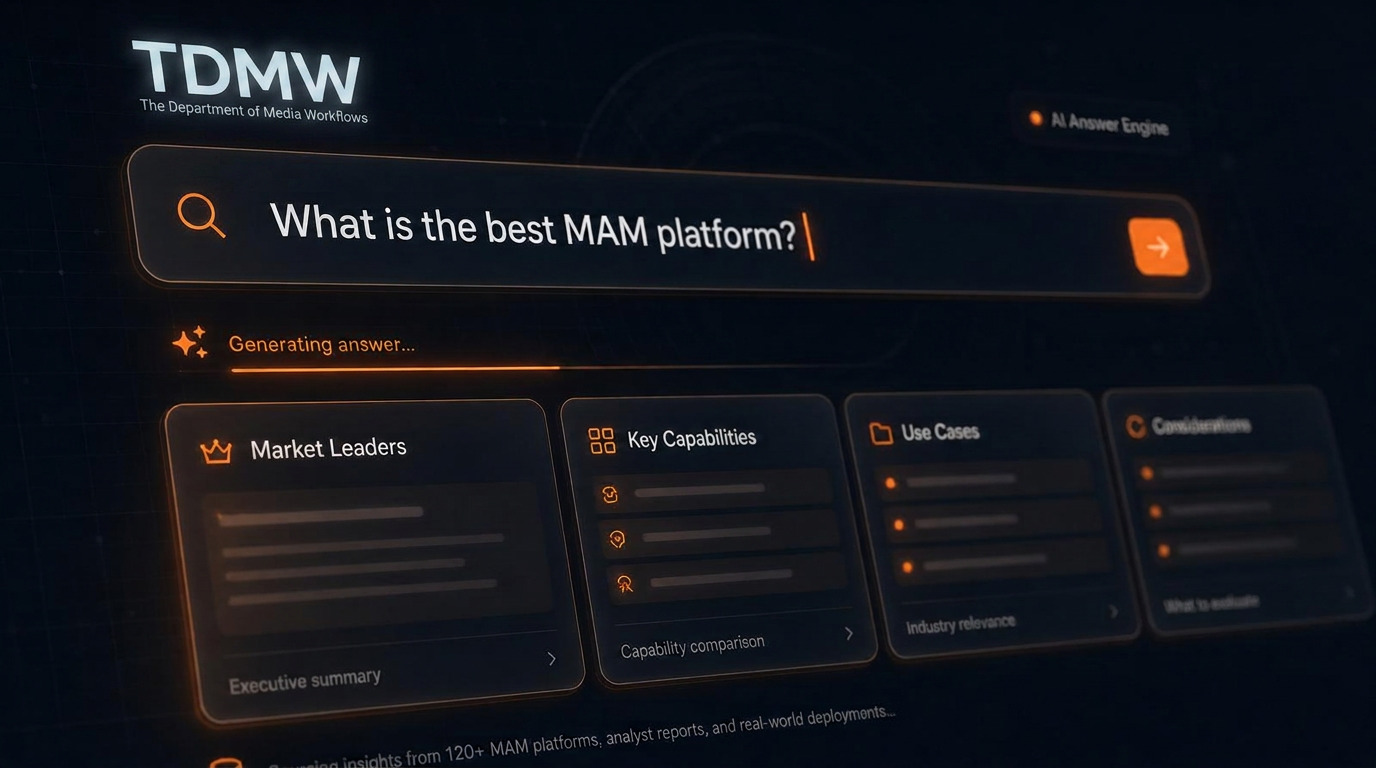
Spoiler: This is the first article in a monthly series tracking how the Media Asset Management market is changing.
Each month(ish), we'll ask the big question above to a range of Answer Engines, crunch the numbers and analyse & track the answers as a signal for where the MAM, and MAM buying is heading.
So, and, why?
What is the best MAM platform?
It is the kind of question a buyer might (or definitely will) ask early in a selection process. They may be building a shortlist, validating a recommendation, comparing vendors, or trying to understand whether the MAM category has changed since they last looked.
The answers generated were useful, and revealing.
It did not point to one universal winner. Instead, even across AI models, it separated the market into different types of platform, each suited to a different operating model.
What was generated
The generated answer suggested that there is no single "best" MAM platform.
Instead, it identified several likely leaders depending on the buyer's need.
If the requirement is a modern, general-purpose cloud MAM, iconik is probably the strongest all-round answer.
If the buyer is an enterprise creative, brand or internal studio team that needs more depth than DAM but less complexity than traditional broadcast MAM, Overcast MAX is highly relevant.
If the requirement is complex media workflow orchestration, especially across production, supply chain, distribution and monetisation, Dalet Flex is likely to be a stronger fit.
If the organisation is already built around Avid editorial and newsroom workflows, Avid MediaCentral remains the most logical choice. Shocking, I know!
That answer is useful because it reflects the reality of the market. But it is also incomplete, because the more interesting point is not simply which vendors were named.
The more interesting point is why the answer had to be segmented in the first place.
What this tells us
The question "what is the best MAM platform?" sounds simple, but the answer exposes a bigger shift.
MAM is no longer one neatly defined software category.
The market now includes cloud-native media collaboration platforms, traditional broadcast MAMs, media supply-chain orchestration tools, DAM-adjacent systems, archive platforms, production ecosystem tools and newer content intelligence layers.
That means search results and AI-generated answers are trying to reconcile platforms that may all describe themselves as MAM, but are not built for the same buyer, workflow or outcome.
A broadcaster managing newsroom production does not need the same platform as a brand managing campaign video. A post-production team working with high-resolution media does not have the same requirements as a sports organisation trying to monetise archive content. A marketing operations team looking for approved, reusable video assets is not solving the same problem as a media supply-chain team delivering content to multiple platforms.
So when an answer separates iconik, Dalet, Avid and Overcast into different use cases, it is not avoiding the question.
It is showing that the category has fragmented.
Why we are tracking this monthly
This is why we are turning the question into a monthly market brief.
Search results are not just a list of links. AI-generated answers are not just summaries. Together, they offer a useful snapshot of how a category is being understood, described and compared.
Each month, we will look at buyer-intent searches around MAM, DAM, content intelligence, media workflows, AI search, hybrid cloud, archive, creative operations and campaign readiness.
We will track which vendors appear, how they are described, what categories are being merged or confused, and which buyer problems are becoming more visible.
The goal is not to create another static vendor ranking. The goal is to understand how the market is moving.
The search result problem
Search for "best MAM platform" and the results are unlikely to give a clean answer.
You will usually find a mixture of vendor pages, software directories, review-site rankings, broad "top MAM tools" articles, paid placements and category explainers. Some results focus on cloud-native MAM. Some lean towards broadcast production. Some blur the line between DAM and MAM. Others group together platforms that solve very different problems.
This is a reflection of the buying reality.
MAM now means different things to different teams. The term is used by broadcasters, sports organisations, archives, post-production teams, brands, agencies, internal studios and enterprise marketing teams. They may use the same language, but they are not always looking for the same product. It makes generic comparisons difficult.
Almost every platform can now talk about metadata, proxies, permissions, workflows, AI, integrations and cloud. But those words do not mean the same thing in every system.
The real difference is not whether a platform has "AI search" or "workflow automation" on a feature page. The real difference is what kind of media operation the platform was built to support.
Why "best MAM" depends on the buyer
For a broadcaster, the best MAM may be the one that connects newsroom, production, archive, playout and distribution workflows.
For a post-production team, the best MAM may be the one that supports remote editing, proxy creation, Adobe or Avid integration, high-resolution media and hybrid storage.
For a sports organisation, the best MAM may be the one that helps teams search, package, reuse and monetise archive and match-day content.
For an enterprise brand, the best MAM may be the one that helps marketing, creative, legal and regional teams find approved video, understand usage rights, manage versions and activate content across campaigns.
Those are fundamentally different requirements and this is why a single ranked list can be misleading. A platform can be excellent in one context and wrong in another.
Maybe instead of:
What is the best MAM platform?
We should probably ask (or buyers should probably ask):
What is the best MAM for which workflow, which team, which content model and which business outcome?
Our view this month
The current MAM market is best understood as four overlapping segments.
The first segment is cloud-native media collaboration. This is where iconik is one of the clearest benchmarks. It is strong when teams need searchable media, hybrid storage, collaboration, review, approval and flexible deployment without the weight of a traditional broadcast implementation.
The second segment is enterprise media workflow orchestration. This is where Dalet Flex is highly relevant. It is better suited to organisations where the problem is not just managing assets, but controlling how content moves through production, supply chain, distribution and monetisation workflows.
The third segment is enterprise creative and video operations. This is where Overcast MAX sits, between DAM and traditional MAM. It is relevant for brands, internal studios, sports organisations and content-rich enterprises that have video complexity, but do not necessarily want the cost or operating model of a full broadcast MAM.
This is especially important because it points to one of the biggest shifts in the market. More organisations now have media-company problems, even if they are not media companies.
They produce large volumes of video. They work across teams, regions, agencies and platforms. They need approvals, permissions, compliance, version control, archive access and reuse. They need to understand not just where content is, but whether it can be used and how quickly it can move into market.
That is pushing MAM beyond its traditional broadcast base.
The fourth segment is production ecosystem management. This is where Avid MediaCentral remains important, particularly for organisations already built around Avid editorial, newsroom and production environments.
The bigger insight: MAM is becoming a content intelligence layer
The most important trend is that MAM is moving beyond asset management.
The old model was about storing, tagging and retrieving files. That still matters, but it is no longer enough.
Modern media teams need to understand what is inside content, where it can be used, who has approved it, what rights apply, which versions exist, how it connects to campaigns or productions, and how quickly it can move into the next workflow.
That is why AI, metadata enrichment, rights data, workflow orchestration, hybrid storage and approval context are becoming central to the category.
The market is shifting from managing media files to managing media value.
That shift is visible in search results, vendor messaging and buyer behaviour. The language of the category is changing. MAM is no longer only a broadcast operations system. It is increasingly part of a broader content supply chain, connecting production, archive, creative operations, marketing activation and commercial outcomes.
How buyers should read the results
When buyers search for the best MAM platform, they should be careful not to mistake visibility for fit.
The platform that appears most often is not necessarily the best platform for the workflow. The most established broadcast vendor may not be the right answer for an enterprise marketing team. The most modern cloud platform may not be deep enough for a complex media supply chain. The longest feature list may not translate into the fastest adoption or strongest business case.
A better way to interpret the market is to start with the operating model.
- Is the organisation managing production media, finished assets, or both?
- Does content live in one repository, or across hybrid storage?
- Are users mainly editors, archivists, marketers, producers, compliance teams, sales teams or external partners?
- Does the organisation need deep orchestration, or does it mostly need search, access, collaboration and reuse?
- Is the priority operational control, creative speed, content monetisation, campaign readiness or cost reduction?
Those questions will usually narrow the category faster than a generic vendor ranking.
Need help making sense of the MAM market?
Choosing a MAM platform is rarely just a software decision.
It is a workflow decision, a content strategy decision and often a change-management decision. The right answer depends on how your teams create, manage, approve, reuse and activate media across the business.
At The Department of Media Workflows, we help media technology companies, content-rich enterprises and video-first teams understand the market, sharpen their positioning, define their requirements and build clearer go-to-market strategies around complex media workflows.
If you are reviewing your MAM, DAM, content operations or media workflow positioning or GTM strategy, we can help you make sense of the options and turn technical complexity into a clearer commercial decision.
Get in touch to discuss your media workflow strategy.